Russell Ackoff
The operations-research pioneer who became systems thinking's great contrarian — and spent forty years arguing that we keep solving the wrong problems, more and more efficiently.
The operations-research pioneer who became systems thinking's great contrarian — and spent forty years arguing that we keep solving the wrong problems, more and more efficiently.
"It is much better to do the right thing wrong than the wrong thing right."
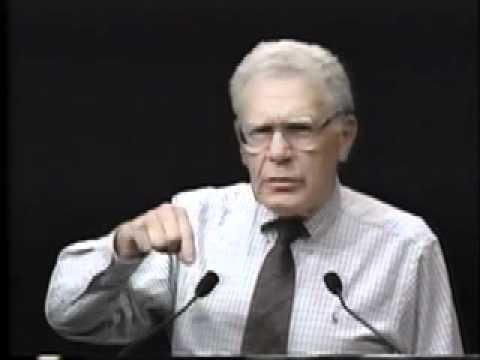
Ackoff was a spellbinding speaker. The fastest way in is his own voice, in this order — then the two idea cards below as the capstone. Click any thumbnail to play it here.
Ackoff's whole worldview rests on one historical claim: Western thought is moving from the Machine Age to the Systems Age. The Machine Age explained everything by taking it apart — reductionism (wholes reduce to indivisible parts) and mechanism (everything is cause-and-effect). The Systems Age reverses the move: every object is part of a larger whole (expansionism), and things have purpose, not just causes.
That flips how you gain understanding. Analysis takes a system apart to see how it works — its product is know-how, knowledge. Synthesis puts the system in the context of the larger whole that contains it, to see why — its product is understanding.
Understanding proceeds from the whole to its parts, not from the parts to the whole as knowledge does.
The reason analysis fails on systems: a system's defining properties belong to the whole and to no part. A car's essential property — transporting you — is held by no single component. So if you improve the parts separately, "you can be absolutely sure the performance of the system as a whole will not improve." It's the argument underneath everything else he did.
Ackoff's five rungs, each answering a different kind of question. He didn't originate the idea — but he added understanding (the rung most versions drop) and the argument that only the top rung raises effectiveness.
The cut that matters: information, knowledge and understanding only raise efficiency; wisdom raises effectiveness ("efficiency multiplied by value"). His barbed corollary — schools pour time into the low rungs and "virtually none" into wisdom, so "students not only don't know, they don't know what they don't know."
Four ways to treat a problem, deepest last:
He favoured dissolution because reality never hands you a clean problem — it hands you a mess: a system of interacting problems. "Managers do not solve problems, they manage messes." Solve one extracted problem in isolation and you usually worsen the others.
Dissolution's method. Ask: if the existing system were destroyed tonight, what system would its stakeholders build right now if they could have anything they wanted? Design that, then work backward.
Only two constraints — it must be technologically possible, and able to survive in today's environment. Note what's dropped: implementation feasibility. The point is to kill the "we could never get there" reflex. (The design must also be built to keep learning and adapting — which is why it's an ideal-seeking system, not a utopia.)
Its full form is interactive planning: formulate the mess → plan the ends (the idealized design) → plan the means → plan the resources → design implementation and control. Participative, continuous, and whole-at-once.
Ackoff's friendly quarrel with the quality movement. He knew W. Edwards Deming personally and admired his systems view, but argued most improvement programs fail because they remove defects and optimize parts separately — which can't improve the interacting whole. Getting rid of what you don't want never gives you what you do. "One never becomes a leader by continuously improving; that's imitation of the leader." Discontinuous, creative redesign is what moves you. (The effectiveness-vs-efficiency distinction he built on came from Peter Drucker.)
"A cemetery or rubbish heap can grow without developing, whereas a person continues to develop long after he or she has stopped growing." Growth is an increase in size or number; development is an increase in the capacity to satisfy needs and desires. You can develop without growing — and mistaking one for the other is, for Ackoff, most of what's wrong with how organizations set goals.
Late in life Ackoff turned his one-liners into a genre: the "f-Law" — a flaw dressed up as a law. A sampler.
"All of our social problems arise out of doing the wrong thing righter. The more efficient you are at doing the wrong thing, the wronger you become."
"A bureaucrat is one who has the power to say 'no' but none to say 'yes.'"
"Managers cannot learn from doing things right, only from doing things wrong."
"Managers who don't know how to measure what they want settle for wanting what they can measure."
"We fail more often because we solve the wrong problem than because we get the wrong solution to the right problem."
"The only thing more difficult than starting something new in an organisation is stopping something old."
"A good deal of corporate planning is like a ritual rain dance; it has no effect on the weather that follows, but those who engage in it think it does."
"When managers say something is obvious, it does not mean it is unquestionable — it means they are unwilling to have it questioned."
"The objective of education is learning, not teaching."
"The lower the rank of managers, the more they know about fewer things."
His practice touched 250+ corporations and 50+ government agencies, through the Busch Center at Wharton and his firm INTERACT.
The exercise Ackoff credited as the origin of idealized design. A VP opened: "the telephone system of the United States was destroyed last night" — now redesign it. The result anticipated nearly every feature the network later grew: touch-tone, call waiting and forwarding, voicemail, caller ID, conference and mobile phones.
His longest engagement. Controlled experiments showed extra advertising barely moved sales; the brewer held marketing spend roughly flat from 1961–1976 while quadrupling sales, its market share climbing from 7% to over 40%.
Participatory planning with residents of a disadvantaged neighbourhood, under the community's own slogan — "plan or be planned for."
His methods implemented across two administrations with J. Gerald Suarez — systems redesign inside government.
Ackoff came out of a four-generation pragmatist line at Penn, which gave him a systems thinking built on participation and purpose rather than pure objectivity:
William James → E.A. Singer Jr. → C. West Churchman → Russell Ackoff
Among the systems-thinking founders he is the design / soft pole. That puts him in sharp contrast with Jay Forrester's system dynamics — which treats a system as having an objective structure best captured by computer simulation, the tradition Donella Meadows descends from. Ackoff instead redesigned systems with their stakeholders. His work carried forward less through students than through institutes: Jamshid Gharajedaghi (a close colleague) operationalized it; Michael C. Jackson situated it within critical systems thinking. The popular link to Peter Senge's learning organization is convergence, not descent — Senge's systems root is Forrester — though they share themes and a common tie to Deming.
Every link below was checked live — real, currently-available uploads of Ackoff's talks, lectures, and interviews. Click a thumbnail to play it here.
Best single starting point: Ackoff's Best (1999), a career-spanning anthology. For the core method, go straight to Creating the Corporate Future.